

Scout a hundred companies. Diligence the three that matter.
An intelligence operating system for the investment workflow: sourcing, screening, diligence and pipeline in one place, where each step hands its work to the next instead of sending you back to a blank search field.
Sourcing, screening and diligence in one workspace. Your pipeline stays inside your team.
Who exists at all?
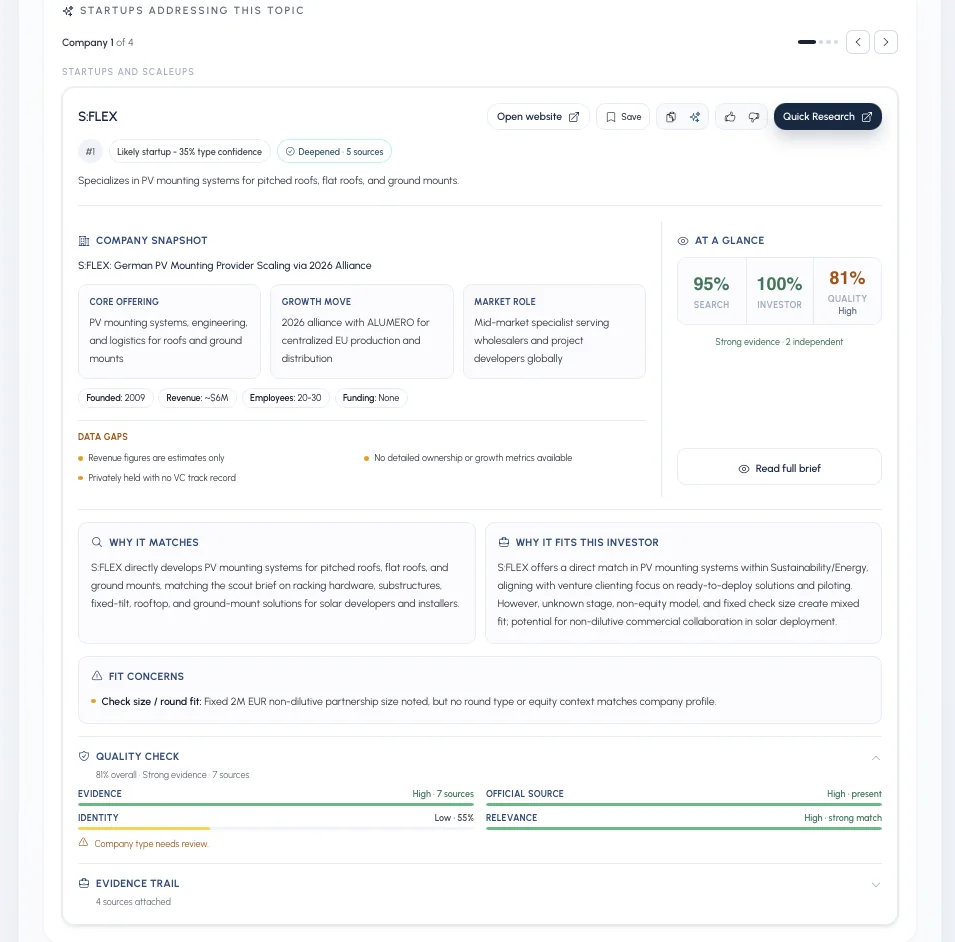
Scout by thesis, technology or founder background — not by someone else's tags.Worth a second look?
Quick Research places every company in the same structure in under a minute.What speaks against it?
Extended Research: landscape, defensibility, risks and the questions to ask.What goes to IC?
Compare, classify, export the report or hand it over by link.Each step hands its work to the next
Most investment research is lost in the gaps between tools — a name found in one place, re-searched in another, pasted into a third, and stale by the time it reaches the memo. In evalue8 the output of each step is the input of the next.
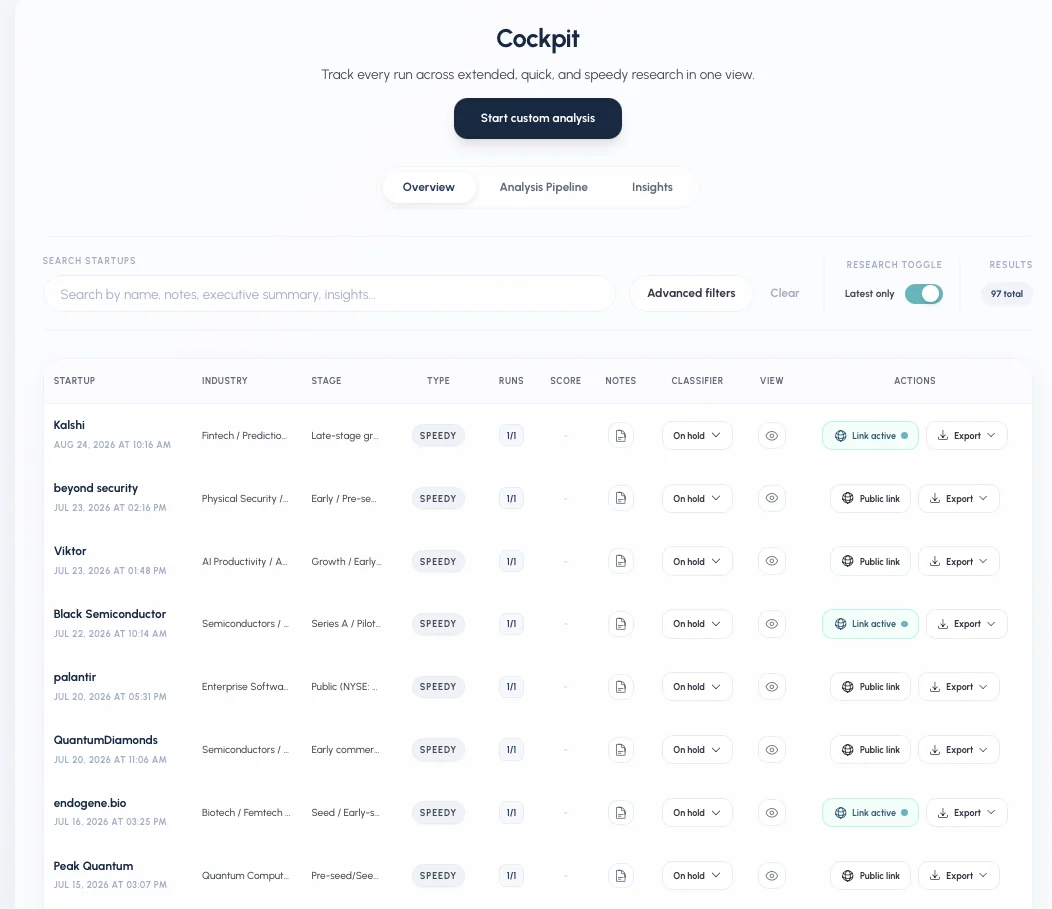
Less time maintaining information. More time with the people behind it.
No re-searching a name you already looked at, no copying between a database and a spreadsheet, no stale company summary in a memo. The time saved is not the point in itself — it is where it goes: forming a view, meeting founders, arguing the deal.
Sourcing that doesn't depend on who you happen to know
Scout searches companies and people. Start from a company you like and find the ones like it, or start from a topic and let it sweep the market. A run takes three to six minutes and can surface up to a hundred companies at once — with the relevant people to contact.
- Similar startupGive it a name and a website — optionally a deck — and get the companies that actually resemble it.
- Topic searchDescribe a thesis in your own words and let it sweep the field.
- People searchFind founders and operators by background, not by job title.
- Watchlists and saved runsKeep a thesis running and come back to what has changed.
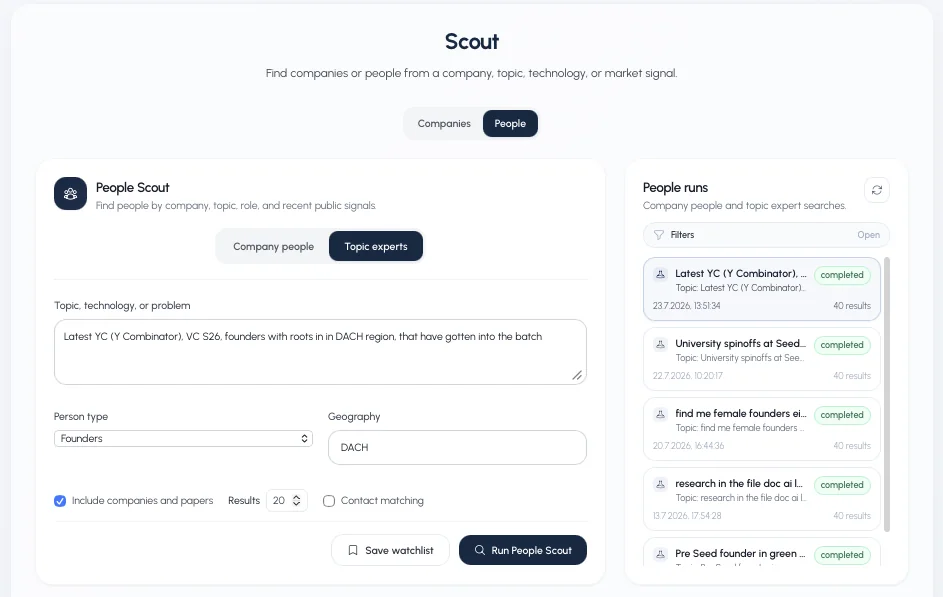
Latest YC batch founders with roots in the DACH region
University spinoffs at Seed or Series A in advanced materials
Pre-seed founders in green tech who incorporated this year
Quantum startups headquartered in Europe with public research backing
Real search patterns from the product. Scout returns a structured list, not a page of links.
Every company placed the same way, in 10–30 seconds
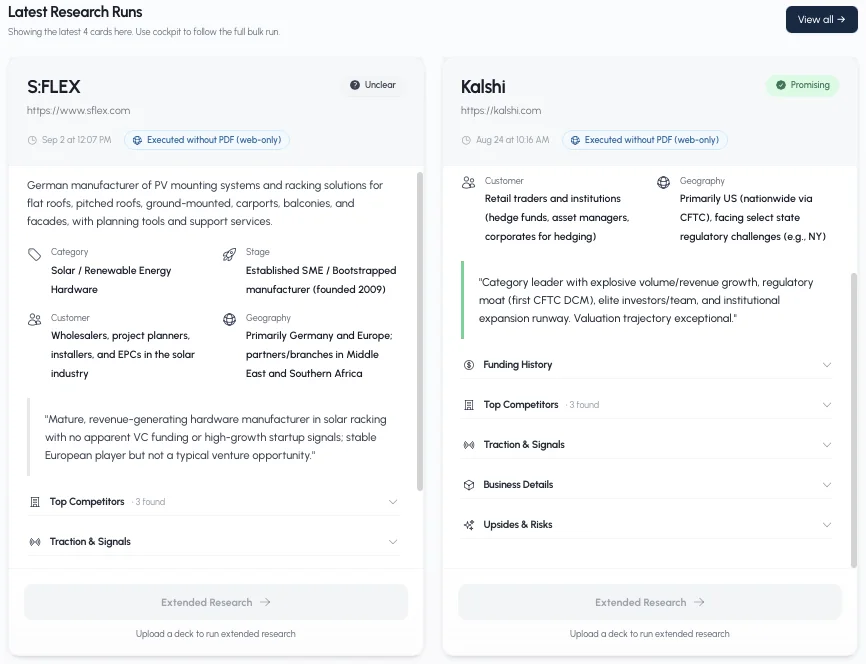
The problem with screening isn't speed. It's that the twentieth company of the week gets a different level of attention than the first. Quick Research gives each one the same structure — and tells you where it fits your mandate.
- Company snapshotWhat they build, stage, customers, geography, funding and size.
- Why it matches — and why it fits this investorScored against your thesis, stage and check size, not a generic ranking.
- Fit concernsNamed explicitly. A mismatch on model or round shape gets flagged before the call, not after it.
- Data gapsWhat could not be established — stated, rather than filled in with something plausible.
- Quality checkEvidence, identity confidence, official source and relevance, each graded.
A first diligence pass that survives a partner meeting
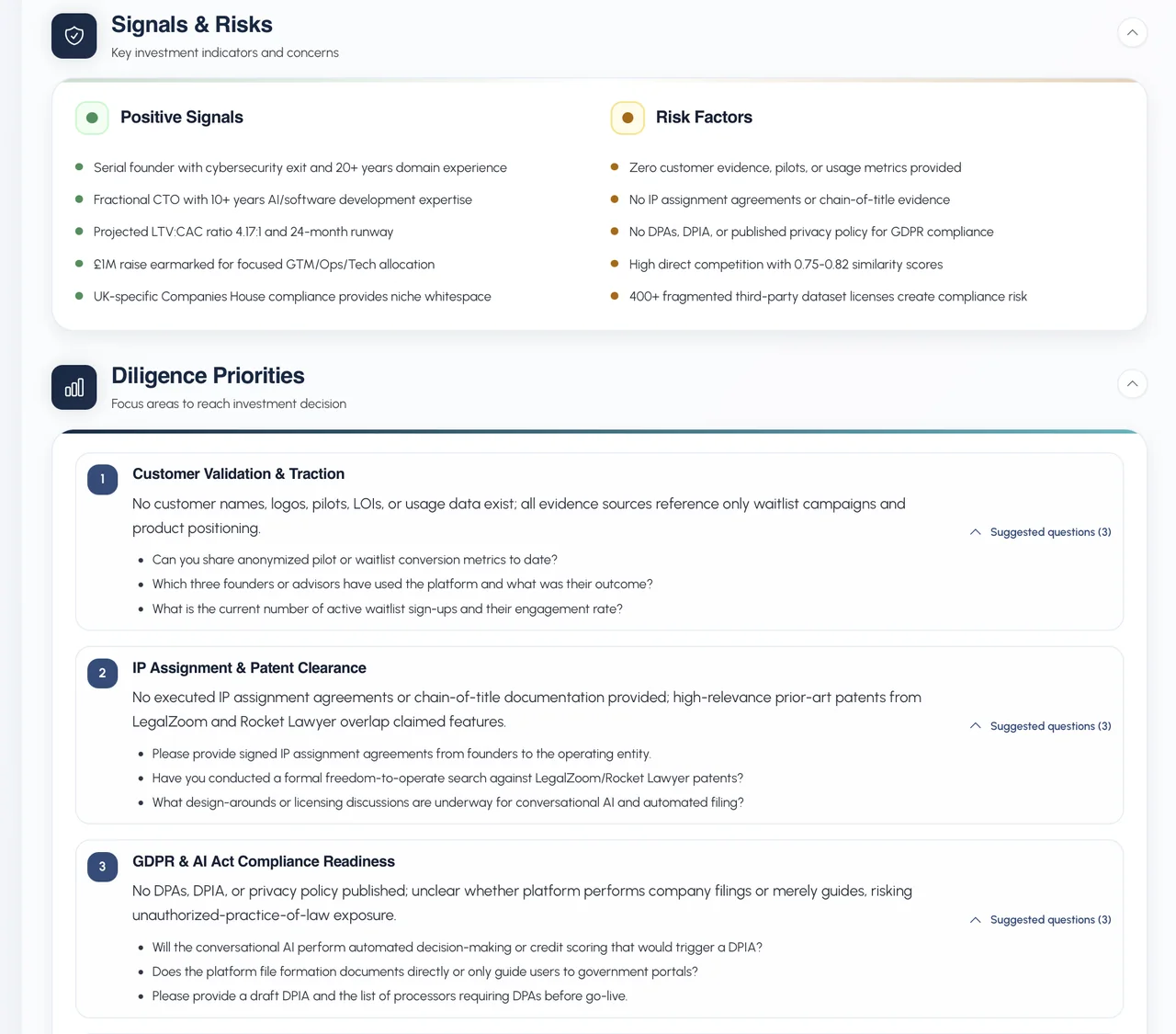
Extended Research takes five to ten minutes and assembles what an IC memo actually needs — with every claim linked back to where it came from.
- Signals & risksPositive signals and risk factors side by side, each one sourced.
- Diligence prioritiesFinancial validation, customer traction, IP and tech moat — each with the specific questions to put to the founder.
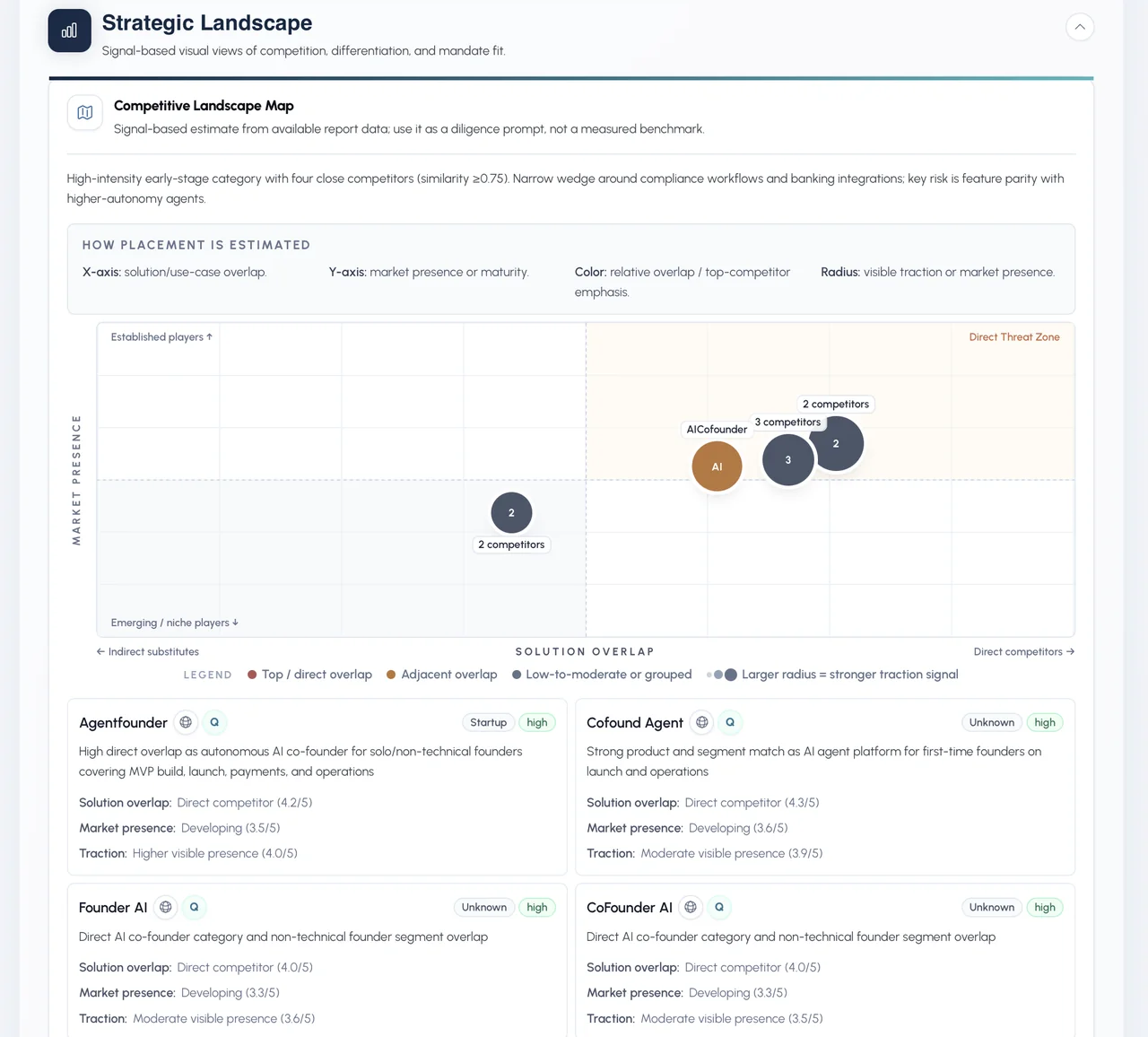
- Strategic landscapeA competitive map positioned by solution overlap and market presence, including the competitors that don't share the category label.
- Defensibility radarDifferentiation, technology, market, team and moat — interpretive, signal-based, and labelled as such.
- Claim validationUpload the deck and every claim in it comes back supported, likely true, insufficient, likely false or contradicted.
Research your partners can open, check and argue with
Companies side by side on the same fields — not on whoever wrote the better deck.
Mark where a company stands in your process and keep the whole pipeline in one view.
A public link for the ones you want a colleague or a co-investor to read.
PDF, JSON or Excel — light or complete — straight into your memo or your model.
Built for teams that have to be right, not just fast
Venture capital
Thematic sourcing, screening at volume, first-pass diligence.
Corporate venture
Strategic fit and technology assessment against the parent's roadmap.
Growth & private equity
Landscape mapping, market structure, buy-and-build candidates.
Venture debt & family offices
Fast, consistent screening without a research team.
Not just "is this a good company?" but "what is the market around it?"
A company only means something in its context. Extended Research places it against the competition by solution overlap and market presence — including the players that do not share its category label.
- Direct and adjacent competitorsGrouped by what they technically do, with overlap, presence and traction scored per company.
- Alternative opportunitiesThe comparable companies you could back instead — so the choice is explicit rather than implicit.
- Market structure and positioningWhere value sits today, and which wedge this company is actually holding.
- Technologies underneathThe approaches in play, and how mature each one is.
You can trace why the system reached an assessment
The reason this can go into a memo is that none of it has to be taken on faith. Every claim in a deck is checked, graded and linked back.
From the deck
Each statement the founder makes, pulled out individually.Checked
Supported, likely true, insufficient, likely false or contradicted.Graded
Evidence strength, identity confidence, official source, relevance.Openable
The evidence trail, so a partner can check it in the meeting.
Replace your stack — or keep it and add the intelligence
Most funds already have a CRM, a database subscription and a way of working. You don't have to give those up to get structured research.
evalue8 as the operating system
Run the whole intelligence workflow inside the platform — sourcing, screening, diligence, pipeline and tracking in one comparable view, with the team working from the same record.
evalue8 as the intelligence layer
Keep the databases, CRM and tools you have. Reach evalue8 research through MCP inside Claude or Codex, through the API in your own systems and automations, or through direct integrations with Google Drive and Attio.
Either way it's the same structured, validated, source-linked intelligence underneath.
Your pipeline stays yours
What a fund researches is a signal in itself. It doesn't leave your team.
Security & privacy overview- Auditable by designEvery statement leads back to a source, an evidence grade and its uncertainty.
- Validated, not just generatedClaim checks, cross-checks, bias controls and human approvals are part of the workflow.
- EU data sovereigntyEuropean hosting, role-based access and clear data separation.
- Model-agnosticThe right model per task, with no lock-in to a single provider.
Does this replace our data provider?
How do we know the analysis is right?
Does it decide for us?
Can we use it on our portfolio, not just on new deals?
What does it cost?
Bring us a company from your pipeline.
We'd rather run Scout and Extended Research on a live deal than walk you through a demo script. You keep whatever it produces.