

Understand your market — and how you look in it.
Map the companies, technologies and competitors around your idea. Then run the same analysis an investment team would run on your own deck — and find the investors that actually fit. Free to start.
In the product your analysis would start here — no account needed until you want to save it.
Free runs to start. No card, no sales call. Add a deck for the deeper read, or run it on your website alone.
Before you pitch a market, find out what's already in it
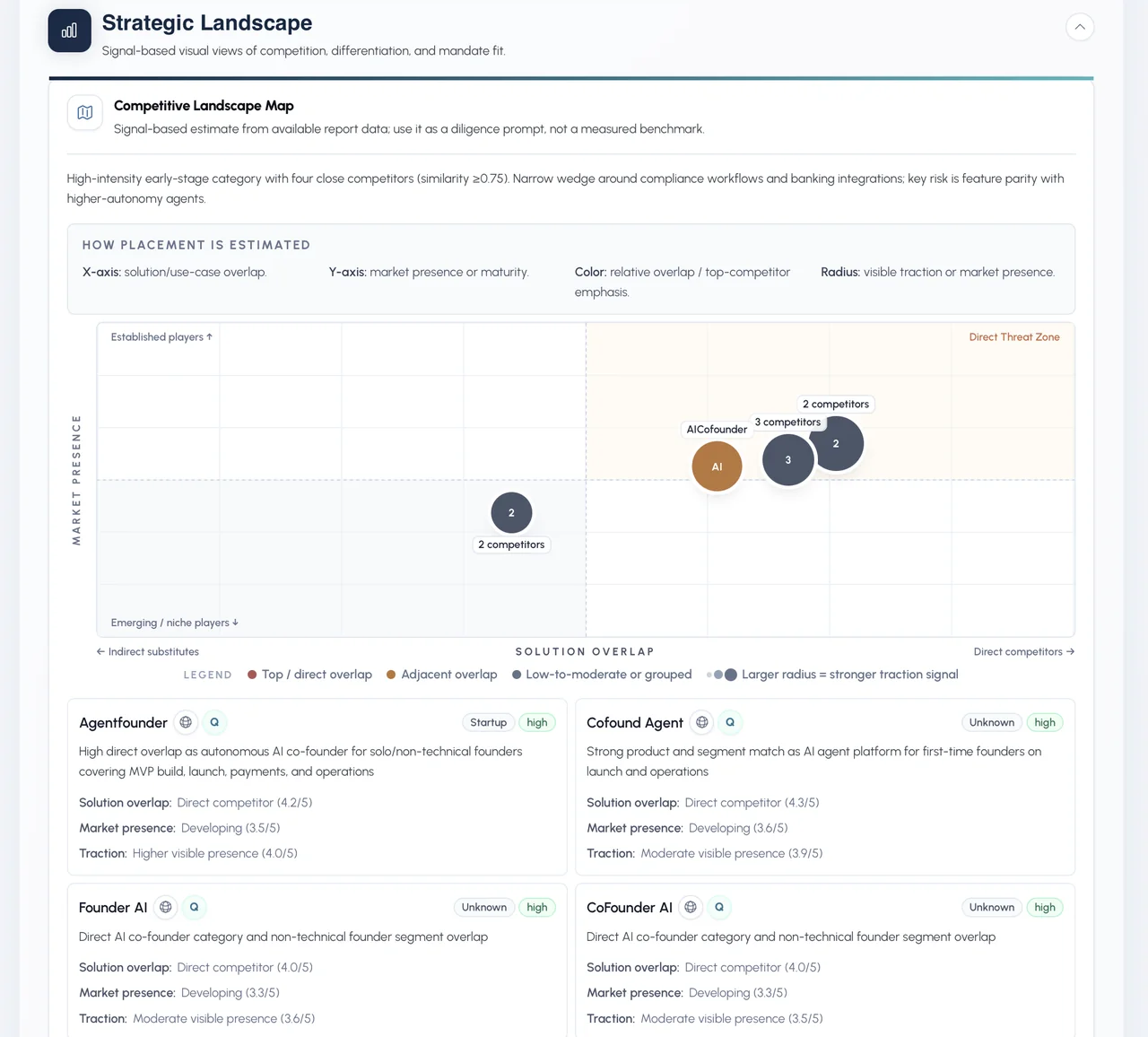
Most first meetings go wrong on the same question: "who else is doing this?" Scout maps the space around your idea in a couple of minutes — the companies, the technologies, the adjacent solutions and the substitutes you might not think of as competitors.
- The landscapeWho is already selling into your problem space, and how established they are.
- The technologiesWhich approaches exist to solve the same thing, including ones you didn't pick.
- Direct and indirect competitionPlaced by solution overlap and market presence, not by category label.
- Where you sitYour own position on that map — which is often not where you assumed.
The same map an investor will build about you. Better to see it first.
The awkward questions, before someone else asks them
Investors research you before they answer. They use the same public sources anyone can reach — and form an opinion from them. You can see that view first.
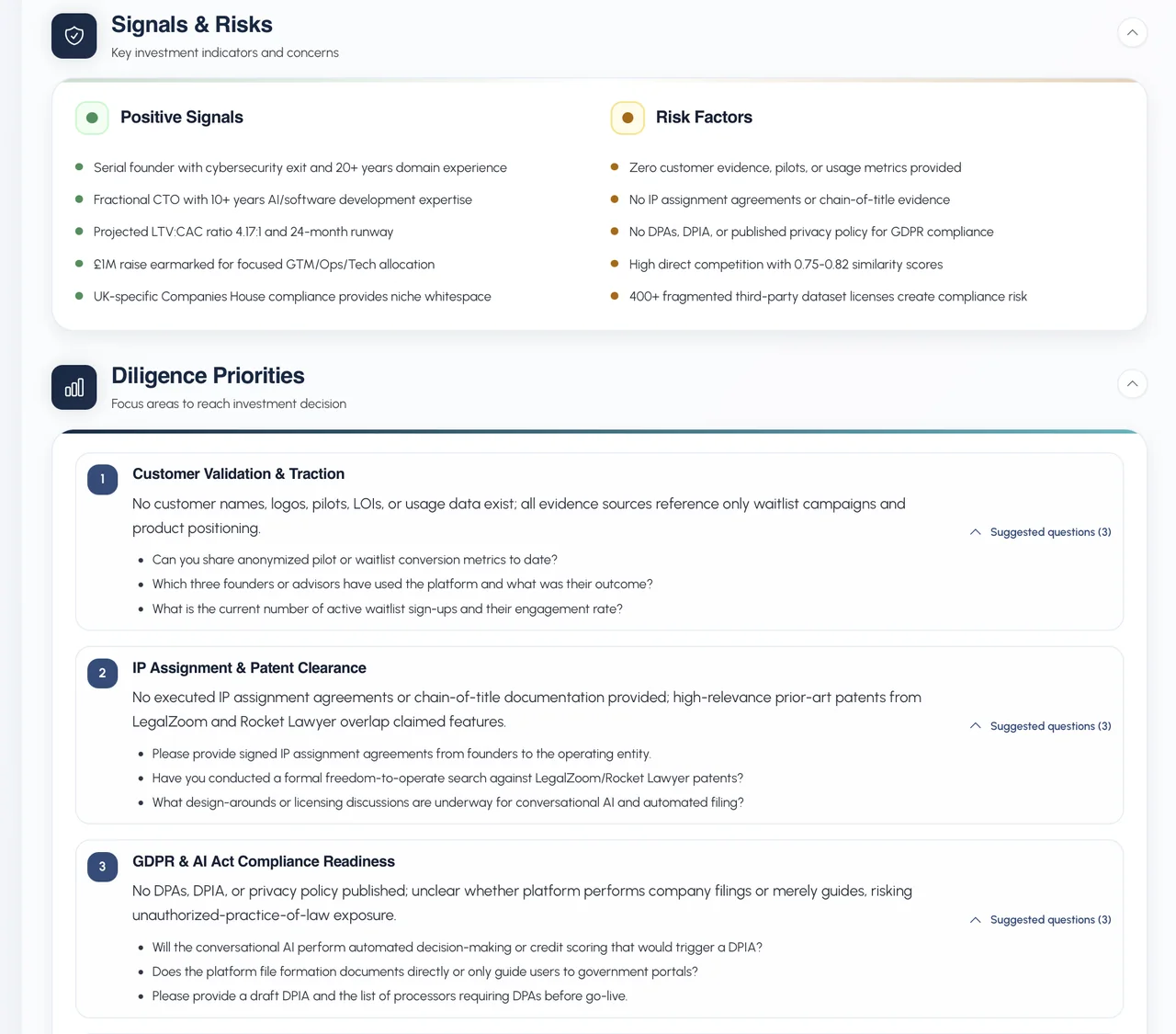
- Your claims, checkedEach statement in your deck comes back supported, likely true, insufficient, likely false or contradicted — with the source attached.
- The competitors they'll nameIncluding the ones solving your problem with a different technology, which you may not be tracking.
- Where your moat actually reads as thinDifferentiation, technology, market, team and moat, each with the reasoning behind it.
- The questions you'll getDiligence priorities, phrased as the questions an investor would put to you.
- What isn't visible yetTraction you have but nobody outside can see is its own finding — and it's fixable.
"Insufficient" is not a failing grade
At early stage most claims aren't publicly verifiable. What matters is knowing which ones — because those are exactly the slides an investor will push on.
Not a list of a thousand funds. The ones that would take the call.
Investor lists are easy to get and almost useless on their own. Fit is what's missing — and evalue8 already assesses it, because that is what the investor side of the product does.
- Market and technologyFunds that invest in your space — including ones that don't advertise your category but keep backing it.
- Stage and geographyWho writes cheques at your size, in your region, now.
- Previous investments and focusWhat they've said they look for, and what they've actually done.
- The peoplePeople Scout finds the partner who would own your deal, with contact matching.
- Fit concernsThe mismatch that would end the conversation in week three — named in week one.
Know something real before the first email
"I saw you invested in X" is not research. Investors read fifty of those a week.
Run the same analysis on a fund that they would run on you: what they've backed recently, how they describe their thesis, which partner covers your space, and where your company genuinely connects to it.
One relevant email beats fifty generic ones — and takes less time in total.
Walk in with the list
Take the diligence priorities from your own analysis into the meeting. Answering the hard question before it's asked is the single cheapest thing you can do for a round.
We also build for investors. So here is the answer to your first question.
Your analysis is yours
We don't show it to investors and we don't sell it.
Signing up doesn't list you
Using evalue8 doesn't put your company in front of anyone.
Your deck stays separated
Documents you upload are used for your analysis, with clear data separation.
Delete it whenever
And it's gone — the analysis and everything derived from it.
Want to be found? That's a switch you flip.
You can choose to be surfaced to relevant investors or included in a relevant newsletter. It is off unless you switch it on, you pick what is shared, and you can switch it off again. Nothing from your analysis reaches anyone automatically.
Start with your free runs. Unlock more one at a time.
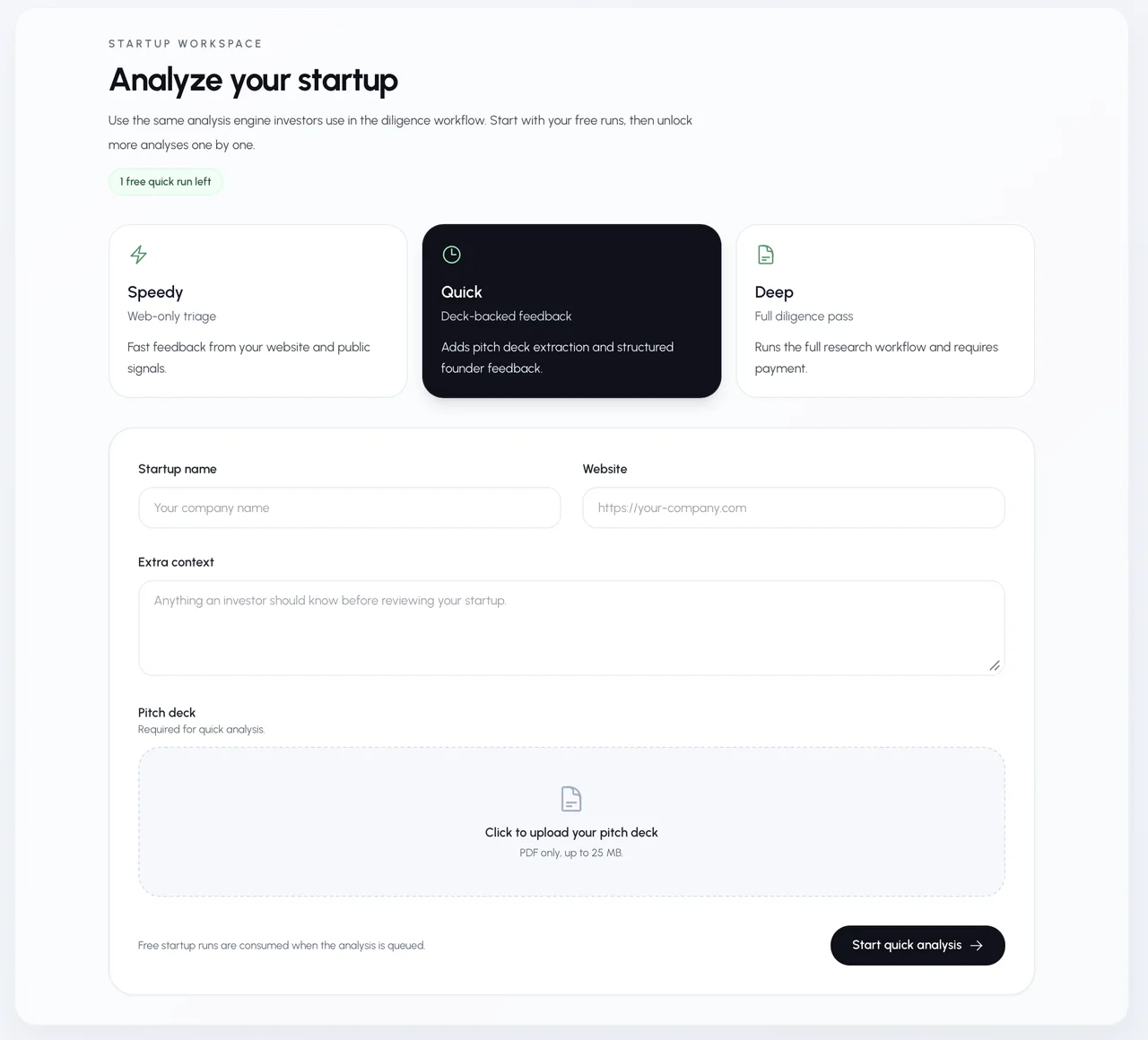
The same analysis engine investors use in their diligence workflow — three depths, and you only pay when you go all the way down.
| Depth | What it does | What it costs |
|---|---|---|
| Speedy web-only triage | Fast feedback from your website and public signals. No deck required — useful before you've written one. | Included in your free runs |
| Quick deck-backed feedback | Adds pitch deck extraction and structured founder feedback: how your company reads, the competitors named, the questions raised. | Free run to start, then unlock more |
| Deep full diligence pass | The complete research workflow — claim validation, strategic landscape, signals and risks, diligence priorities and readiness rating. | Paid, per run |
Free runs are consumed when an analysis is queued. No subscription and no card to start, and whatever you run stays yours.
See what an investor sees.
Takes a few minutes. No account until you want to keep the result.
In the product your analysis would start here.